This fascinating video from the US Federal Judiciary Channel shows an interpreter who worked at the 1945 Nuremberg Trials describing the origins of simultaneous translation techniques.
Category Archives: Articles
What exactly is comparative law?
Continuing with my mini-series “What exactly is…” (following on from What exactly is forensic linguistics? and What exactly is a lawyer-linguist?), today let’s take a brief look at the subject of Comparative Law.
The Oxford Handbook of Comparative Law* describes the discipline as “time-honoured but not easily understood in all its dimensions”. According to Michael Bogdan**, comparative law may be defined as “the comparing of different legal systems with the purpose of ascertaining the similarities and differences“.
Spanish bailout conditions impenetrable behind a thicket of legalese (or not)
As readers know, I do like a bit of legalese 🙂 – see recent posts on whether Business-ese is worse than legalese, and Translating through the fog.
 Today, hot off the presses of Reuters and the UK’s New Statesman, questions are being raised about the legal conditions governing the ranking of Spain’s creditors, citing part (Section 2.19, (b), (i), (B)) of the Credit Derivatives Definitions issued by the International Swaps and Derivatives Association (ISDA).
The following paragraph is being used as an example of impenetrable legal theory. You will notice liberal use of acronyms in the above articles (one of my favourite things… see here):
- CDS – credit default swaps
- EFSF – European Financial Stability Facility
- ESM – European Stability Mechanism
Translation of ancient Chinese legal texts ‘as important as the Dead Sea Scrolls’
The University of California Santa Barbara has issued the following press release:
UCSB History Scholar Translates and Interprets Ancient Chinese Legal Texts
In an ancient tomb in China’s Hubei Province, archeologists discovered a basket of medical, mathematical, and legal texts that date back to the late third and early second centuries B.C. A historian at UC Santa Barbara is working to translate and interpret the legal texts, of which there are two, and describes them as “a gold mine of social and legal history.”
Reporting from Caserta – Part 2
This second post includes a further selection of papers from the conference Law, Language and Professional Practice held in Caserta last week. Apologies to all those whose presentations have not been included here – there were two or three parallel sessions at the conference, and it was impossible to attend all of them. However, the full book of abstracts can be downloaded.
Reporting from Caserta – Part 1
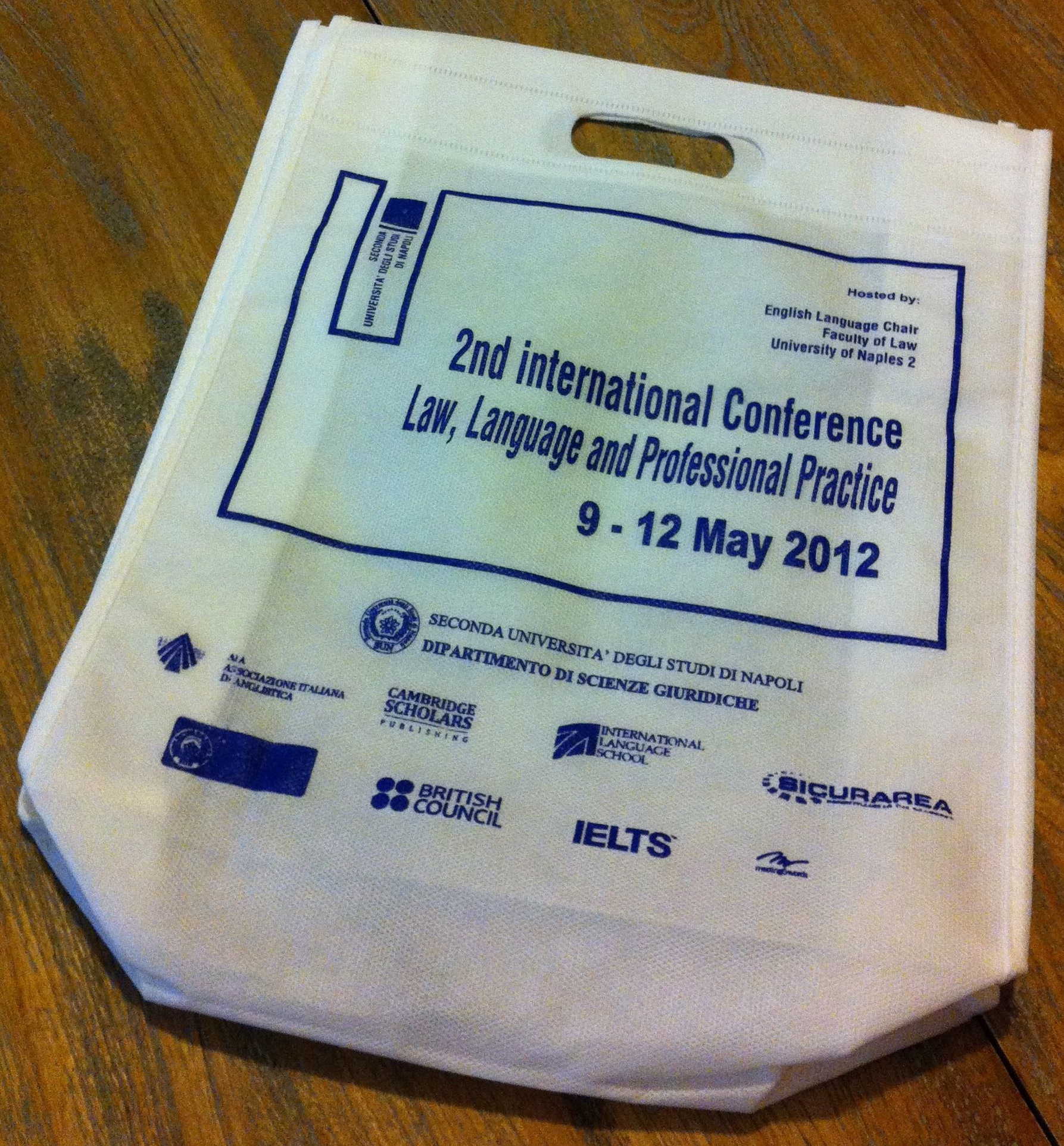 Today, dear readers, I offer you a report from the conference “Law, Language and Professional Practice“, held last week in Caserta, near Naples, Italy, and attended by delegates from every continent. The book of abstracts can be downloaded from the conference website.
I have made a subjective selection of presentations, aiming to give you an idea of the wide range of topics covered. The conference was attended by scholars, advocates, translators, interpreters, teachers of legal language, and government officials, amongst others.
Translating through the fog
 The other day I came across this nice clean web-based tool which calculates the Gunning Fog readability score for a piece of text. Just for fun, I put a few sentences from a translation I was then doing (on VAT legislation!) into the tool. It came up with scores ranging between 23 and 29.4 depending on the sentences I chose.
Gunning Fog is not the only readability indicator – others include Flesch-Kincaid, SMOG (Simple Measure of Gobbledygook), and Coleman-Liau. A comprehensive article by Ronald & Ruth Reck describes a number of them in detail. There are also lots of simple online tools available.
Zen and working methods
 A very interesting article in the Law Society Gazette last week about flexible working patterns grabbed my attention. Here is a taster: “The term ‘work/life balance’ has such negative connotations in private practice that some firms have banned it from their vocabulary.” The article deals particularly with the problems female lawyers have, but not only – it also talks about flexibility enabling men to pursue parallel careers as well, “such as writing a book or singing in a choir”.
Translators, on the other hand, rather than having the problem of getting out of the office, sometimes have a problem with staying at home too much. A great post over at Patenttranslator’s Blog – “Translator’s Dementia (TD) – What it is and How to recognize the Signs” includes a lovely description of the typical “home office” :). Jill Sommer, on the other hand, gave some really good advice for those who work at home in her 2009 post “Establishing a work-life balance and overcoming loneliness“.
So, following in the estimable footsteps above, here’s my seven-point guide.
‘Business-ese’ may be worse than legalese
 I don’t fully agree with plain language campaigns as regards legal documents – I guess I go along with those who say that the law has to be precise enough and should be interpreted by experts – i.e. lawyers and the judiciary rather than non-specialists – but I certainly think that a lot can be (and is being) done to make legal language more accessible where possible.
Compendium of legal translation degrees offered by universities
 In this post, I hope to give you some examples of the legal translation and interpreting degrees available. Please do write in if you know of others that I haven’t included here.
Most are on-site courses, but a number involve distance learning to varying extents.
The information below has been taken from the relevant university websites and direct correspondence. If any details are incorrect, I would be happy to change them upon request from the institution concerned.
I have listed the courses in alphabetical order of their location.
 From Words to Deeds: translation & the law
You must be logged in to post a comment.