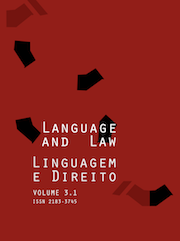
Open access journal – Special issue on legal translation

Capa31Language and Law/Linguagem e Direito is an international online journal edited at the Faculty of Arts of the University of Porto, Portugal, and the Federal University of Santa Catarina ­- UFSC, Brazil. The journal is published twice a year, and includes articles in all varieties of both Portuguese and English.

A special issue on legal translation has just been published, although articles on the subject do appear in other issues too.

Continue reading

Stop Press! Conference on law & language, Haifa

A4The Sixth International Conference on Law, Language and Discourse will take place at the University of Haifa, Haifa, Israel from 1-4 August 2016. The theme is “The development of legal language and its interpretation: Linguistic and pragmatic aspects of the evolution of the synchronic understanding of legal texts”. Despite the proximity of the date, registration is still open.

Previous conferences held in China and Sweden have also examined the theme of how synchronous understanding of legal language and judicial interpretation has developed through history.

Continue reading

Book review – Contract Law, A Comparative Introduction

contractlawI’m sure that many of you will be interested in a book published in 2014 by Edward Elgar Publishing entitled “Contract Law: A Comparative Introduction“. The author is the estimable Jan M. Smits, Professor of European Private Law, Faculty of Law, Maastricht University, The Netherlands.

“This book offers a unique introduction to contract law by means of a comparative approach. It treats contract law as a discipline that can be studied on the basis of common principles and methods without being tied to a particular jurisdiction or legal culture.”

Continue reading

Fourth Roundtable in Forensic Linguistics & Phonetics, Mainz, Germany

mainz antiquaThe Germanic Society of Forensic Linguistics (GSFL) is holding its Fourth Roundtable in Forensic Linguistics & Phonetics in Mainz, Germany from 27-28 August 2016, preceded by a Student and Emerging Scholars’ Day on 26th August.

It aims to “provide forensic linguistics/forensic phonetics researchers, educators, and practitioners the opportunity to present and discuss their work within an interdisciplinary, supportive, and respectful scholarly environment”.

Continue reading

Machine learning & the law

bigdatalearningAs many translators question the future in view of the rise of machine learning, and in the legal domain in particular due to concerns about quality, confidentiality, and reliability of translations, I noted with interest a presentation about legal analytics, and how big data and machine learning is being applied to the tasks that lawyers undertake.

Continue reading