 To start the week with a… groan?
Did you hear about the man who sued an airline company after it mislaid his luggage?
To start the week with a… groan?
Did you hear about the man who sued an airline company after it mislaid his luggage?
 Just before the summer saw the publication of ‘Interdisciplinary Comparative Law: Rubbing Shoulders with the Neighbours or Standing Alone in a Crowd‘ by Jaakko Husa.
In particular, Chapter 3 addresses the significance of language for comparative law by asking what is comparative law’s relation to other disciplines that study language? The chapter focuses on legal translation but also discusses, more generally, comparative legal linguistics and its relation to the comparative study of law.
 The Unitary Patent (UP) and Unified Patent Court (UPC) will become a reality in April 2023. It will have a profound and lasting impact on the European patent landscape. Described by EPO President, António Campinos, as “the most important change in the European patent system since the EPO took up its operations in 1977”, it will inevitably bring about a significant change to the patent strategies of businesses and patent advisors alike. Continue reading
 The European Parliament is offering paid traineeships for a period of 5 months. Trainees can expand their translation and linguistic skills, or gain experience in IT, administration, planning or communication, all while learning more about the activities of the European Parliament. Continue reading
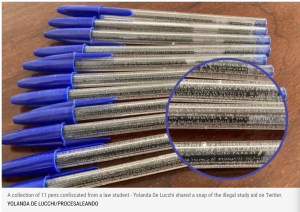 An elaborate scheme for cheating at law exams hit the media last week. A few years ago, in Spain, a law student apparently etched (!!) a number of Bic biros with crib notes. Newsweek reported: “The pens were confiscated from a student ‘a few years ago’ during an exam on ‘criminal procedural law’ and they only resurfaced while a law professor was recently tidying up her office.” Continue reading
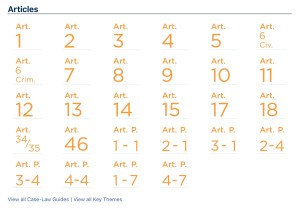 The European Court of Human Rights has just launched its Knowledge Sharing platform (ECHR-KS). The mission is to share Convention case-law knowledge, complementing the existing information tools such as HUDOC*.
You can investigate case-law knowledge through a particular Article/Transversal Theme as well as through materials and links of more general case-law relevance. Continue reading
 “Dans cet ouvrage, Sylvie Monjean-Decaudin met au jour une grille de lecture et pose les bases d’une véritable théorisation de la juritraductologie, qu’elle définit comme un nouveau champ d’étude interdisciplinaire à la confluence du droit, des langues et de la traduction, puisant ses racines dans les sciences juridiques et dans les sciences du langage. Bien que la traduction juridique ait des ramifications historiques lointaines, ce n’est que dans les années 1990 que la juritraductologie prend véritablement son essor.
Face au phénomène de mondialisation et à partir du constat de la vulnérabilité linguistique des personnes, l’auteure montre à quel point la question de la langue du droit est liée à l’accès à la justice. Au-delà des enjeux de traduction dans les instances supranationales et européennes, les États plurilingues et pluri-juridiques doivent également faire face à des défis spécifiques liés à la formulation plurilingue de leur législation.” Continue reading
 Oh this really strikes a chord, doesn’t it? 😊
And do you notice the natty collar too? 🤣
 I am delighted to announce that the conference programme for the conference “Legal Translation and Risk” is now fully final, and we are good to go for Saturday 28 to Sunday 29 January 2023.
Don’t miss out, if you don’t have a place yet, register now!
To make this conference another roaring success and make sure it raises awareness of legal translation globally and across all sectors, please share this news in any way you can – not just to legal translators but to lawyers and anyone with a stake in diligently translated legal documents. Continue reading
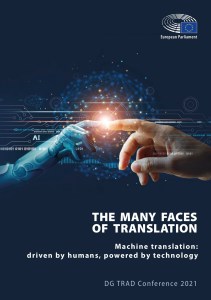 The Directorate-General for Translation (European Parliament) has recently published a compilation of six contributions from its biennial internal conference, entitled “The Many Faces of Translation – Machine translation: driven by humans, powered by technology“.
“The theme of the 2021 conference was ‘Machine Translation: driven by humans, powered by technology’. Over the course of the two days, we explored how humans and machines can work together efficiently. One aspect was particularly important to us: the ethical aspects of artificial intelligence (AI). There is no doubt that AI has already become a key technology. The European Union needs to keep up with progress in this field. However, cutting-edge technology is not an end in itself. While AI should be part of our toolbox, humans must always be front and centre.”
 From Words to Deeds: translation & the law
You must be logged in to post a comment.