 There will be a talk on the IT tools used by European Commission translators at 14.30 on Wednesday 28 November at the EC Representation in the UK (Europe House, 32 Smith Square, London, SW1P 3 EU). Please find below more information on the presentation and details of how to register for the presentation.
Before & after the DSK affair – Review
A few weeks ago, I was invited by Jonathan Goldberg of the blog Le mot juste en anglais to review a paper, Les conceptions juridiques du harcèlement sexuel en France et aux USA – Avant et après l’affaire DSK¹, comparing the way in which the law sees sexual harassment in the United States and in France. I am thus in the slightly odd position of reviewing a paper originally written in English, but finalized in its French version, where my review itself is to be written in both English and French! Anyway, back to the point.
 One of the opening statements in Abigail Saguy’s article is the affirmation that the Dominique Strauss-Kahn (DSK) scandal could only have erupted in the USA². She then analyses the laws, legislative debate and case law over a period from the 1960s (in the US and rather later in France) to the present, in support of her argument that the scandal has also changed the “political and legal landscape” and “might influence the way in which France deals with sexual harassment cases in the future”.
Monday smiles – Pleading
I really liked this one – hope you do too!
iPad app – TransLegal dictionary
This electronic dictionary of law in English could be useful to both non-native lawyers and translators. Don’t be fooled by the clear and simply written definitions – it contains plenty to content even those with a high level of English – as an example have a look at the screenshot below showing collocating words and phrases for “proximate cause” in context.
Stop press – EU translation memories updated *again*!
 Following my post in April, I would like to let you know that the translation memories made available by the Directorate-General for Translation at the European Commission Joint Research Centre have been updated for the second time this year.
In the April 2012 release, documents up to 2010 were included. Now, 2011 data has been added – a further 6 million translation units. Somewhat confusingly, the new update is called “DGT-TM-2012” even though the data is from 2011.
New features of DGT-TM-2012 are:
- Small amounts of Irish data are now included for the first time;
- Significantly more data for the Bulgarian, Maltese and Romanian languages;
- Mostly about 285K new translation units per language.
 The translation memories are parallel texts of the entire body of European legislation, comprising all the treaties, regulations and directives adopted by the European Union (EU), in 23 languages: Bulgarian, Czech, Danish, Dutch, English, Estonian, German, Greek, Finnish, French, Hungarian, Irish, Italian, Latvian, Lithuanian, Maltese, Polish, Portuguese, Romanian, Slovak, Slovene, Spanish and Swedish.
You can download them from this page. Scroll down to “DGT-TM-release 2012” for the 2011 data. Information on how to produce bilingual extractions appears on the same page.
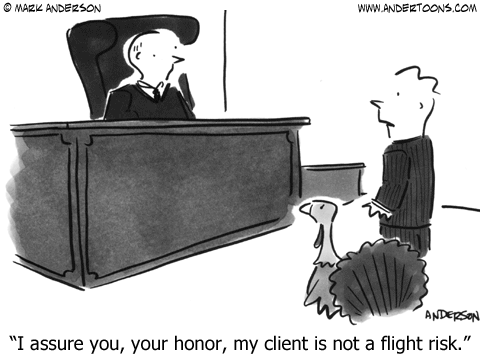
Monday smiles – Jail bird
To start the week off… this cartoon from Mark Anderson’s website Andertoons.
Guest post – Reporting from Montreal
 It is my great pleasure to introduce a guest report on the Sixth Summer Institute of Jurilinguistics held at the end of August, written by Jean Leclercq, co-author of the erudite and multifaceted blog Le mot juste en anglais.
Leclercq trained both in literature and the law, and worked as a translator, from English and Spanish to French, at the headquarters of the World Health Organization in Geneva for 26 years. Retirement hasn’t stopped him translating, often on a voluntary basis, and keeping extremely active through various linguistic and online activities amongst others. A vous Jean !
Multilingual glossary on secure documents
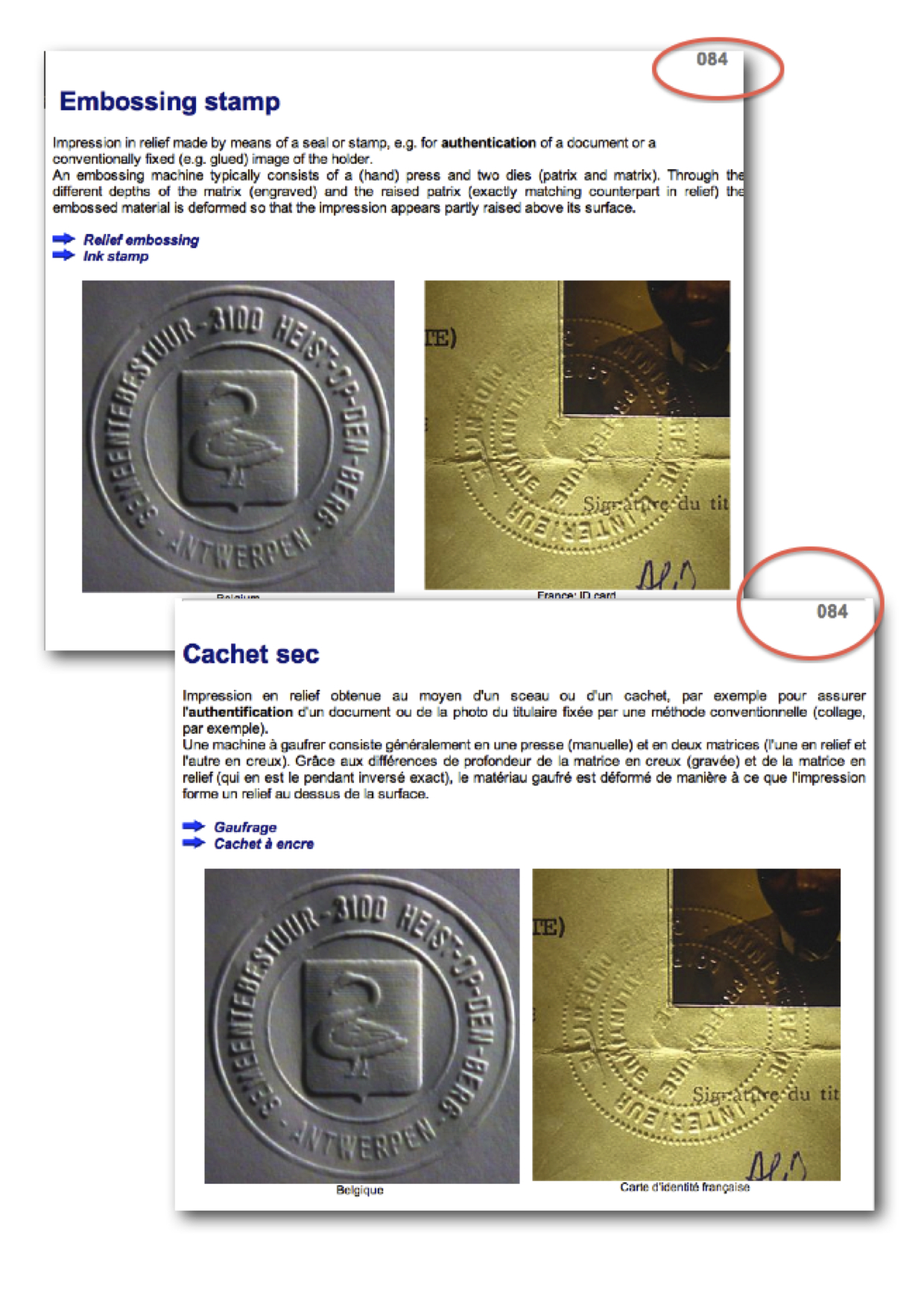 If you work with official and/or secure documents or with descriptions of how those documents are produced, you might be interested in this glossary published by the Council of the European Union (Consilium).
Stop press – Official forum to collect evidence on UK court interpreting scandal
 The ongoing scandal in the UK relating to the outsourcing of court interpreting services to Applied Language Solutions/Capita (see this post) reached the Parliamentary select committee last week, which can watched online at: http://www.parliamentlive.tv/Main/Player.aspx?meetingId=11582
The Justice Committee has launched a call for evidence as an online forum (kudos for being so up-to-date!) but it will close in two days, on 2 November 2012.
Monday smiles – British Judge rules that iPad is cool
First of all, apologies to those of you who have already heard about this – I only just found out, thanks to Daily Tech. Now you may know that I’m an iPad fan (see this post about useful apps), so I just had to blog about this development in the battle over patents between Apple Inc. and Samsung Electronics.
 From Words to Deeds: translation & the law
You must be logged in to post a comment.