 Do you know about MOOC? Neither did I until recently. It stands for Massive Online Open Course, and the edX program, founded by MIT and Harvard, includes courses from a number of leading universities worldwide.
Monthly Archives: February 2013
Family law termbank – Australia
A joint project in Australia between the Attorney General’s Department and Macquarie University’s TermFinder group in the Centre for Language Sciences has led to the production of LawTermFinder – an online termbank of words and phrases frequently used in Australian family law.
Conference – Language issues in EU law, Opatija, Croatia
 A multidisciplinary international conference is to be held in Opatija, Croatia from 19-20 April 2013, entitled Language Issues in EU Law in the light of Croatian Accession, at Jean Monnet Centre of Excellence.
A wide range of topics will be covered: EU multilingual lawmaking, theoretical approach to legal translation in the EU, legal translation and comparative law, the impact of English on the translation of EU legislation, interpretation of multilingual legislation at the CJEU, multilingualism as an obstacle to harmonization, the call for a new legal culture, the fiction of autonomous EU legal concepts, creating Croatian terms for EU legal concepts, role of the Croatian language in the EU, new challenges to Croatian judges, implementation of Directive 2010/64/EU regarding the right to interpretation and translation in criminal proceedings, and others.
Target audience: lawyers and linguists from academia, translators, court interpreters, judges.
For more information see the conference website.
Monday smiles – Hoofed ruminants
 If you are over 40, and especially if you are English, you probably know the drink Babycham. A cute leaping deer with a bow… ring any bells?
Open seminar on legal translation, Portsmouth, UK
 An open seminar is to be held at the University of Portsmouth in the UK on Friday 8 March, from 12 noon to 4 pm.
Two events are planned, as well as a networking lunch. Here are the details:
Greetings on International Mother Language Day
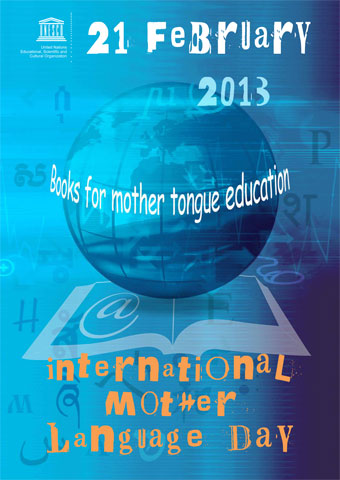 Today is International Mother Language Day, proclaimed by UNESCO to promote linguistic and cultural diversity and multilingualism. I was made aware of this by the United Nations Online Volunteering program (UNV), that I have posted about before.
Life as a judge and rapporteur public
 It is a real pleasure to introduce today’s guest post in the form of an interview with Johann Morri, a judge at the Administrative Court of Versailles, in France. He studied law both in France and in the United States, where he was a law clerk for a Federal Judge in the District of North California for several months. He also served at the French Ministry of Economy, Finance & Industry, where he led the international law office within the Department for Legal Affairs.
Monday smiles – First known quintuple negative
Australian Experts Report First Known Quintuple Negative
A person whose native language is said to be English created the following sentence recently:
Polish WordNet
 Following Wednesday’s post about the Bengali WordNet, I have received information about the Polish version.
The Polish wordnet – plWordNet – is a semantic network which reflects the Polish lexical system. The first ever WordNet was built in the late 1980s at Princeton University (see this post). plWordNet is one of few such resources built not by translating the English WordNet, but from the ground up, in a joint effort of lexicographers and computer scientists. It can be browsed online here: http://plwordnet.pwr.wroc.pl/wordnet/. It is the second largest wordnet in the world.
If you would like to read more about designing wordnets, see this book: http://nlp.pwr.wroc.pl/en/ksiazki/92/show/publication
Acknowledgement: Many thanks to Professor Stan Szpakowicz for granting permission to publish this post.
Bengali WordNet
 Researchers at the Indian Statistical Institute have developed a lexical database for Bengali called WordNet. I have posted before about WordNet based at Princeton University in the United States.
Here is what the Indradhanush WordNet Consortium say about their project:
 From Words to Deeds: translation & the law
You must be logged in to post a comment.