Reporting from Caserta – Part 1

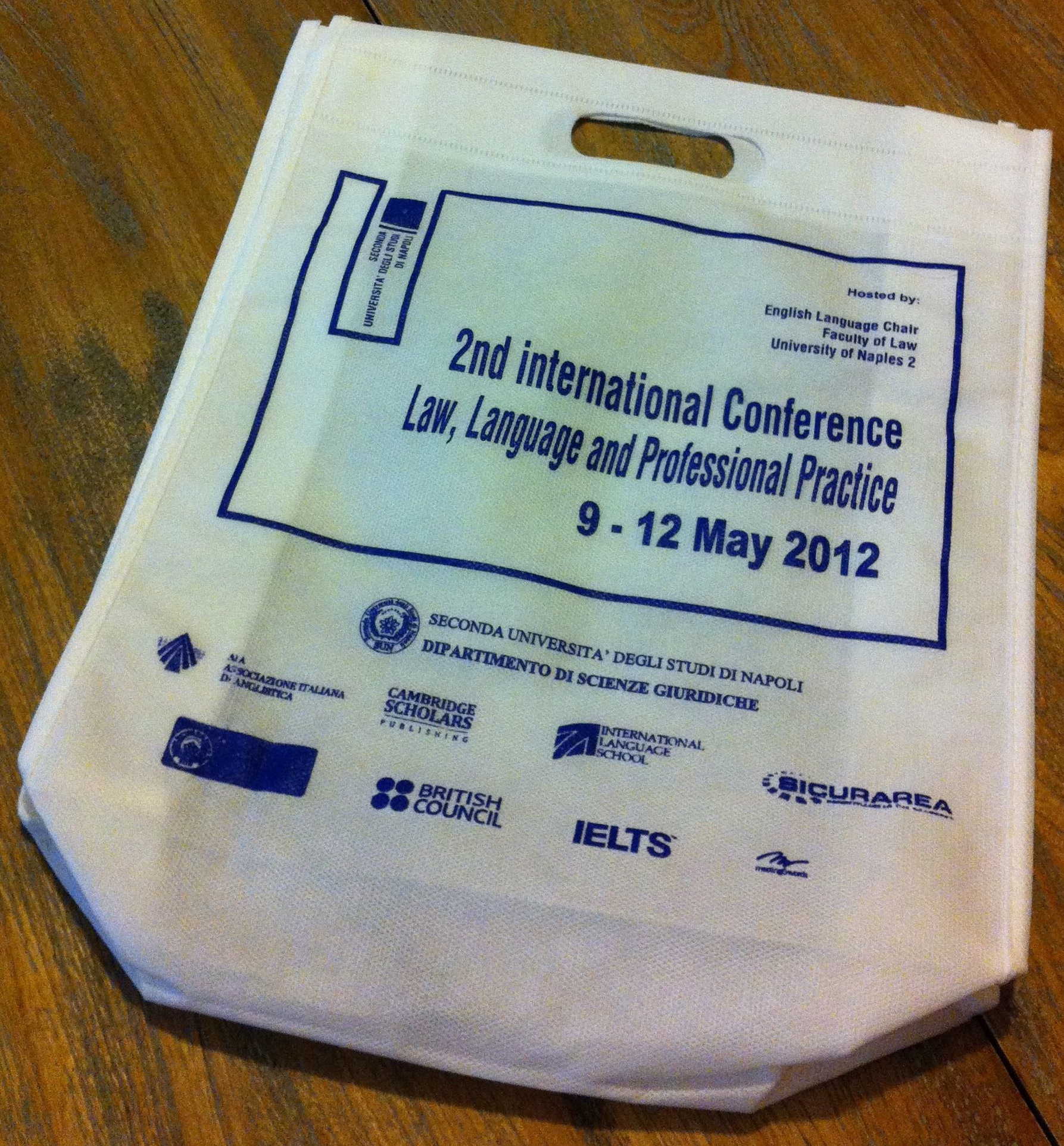
Today, dear readers, I offer you a report from the conference “Law, Language and Professional Practice“, held last week in Caserta, near Naples, Italy, and attended by delegates from every continent. The book of abstracts can be downloaded from the conference website.

I have made a subjective selection of presentations, aiming to give you an idea of the wide range of topics covered. The conference was attended by scholars, advocates, translators, interpreters, teachers of legal language, and government officials, amongst others.

Continue reading

Easter Monday smiles – English beaches are grassy green

A High Court ruling has confirmed that some beaches can be registered as ‘village greens’. No, this isn’t a late April Fool. Great, isn’t it!!

Mr Justice Ouseley, in a judgment of 21 March last, stated “I can see no answer to the contention that the ordinary meaning of the words used by Parliament to define “town or village green” are broad enough to permit the registration of a tidal beach, provided that the nature, quality and duration of the recreational user satisfies the statutory test.”

Continue reading

WordstoDeeds update

This post is just to let you know about a few small changes around here.

First of all, the blog’s banner name has switched around – as you can see at the top of the page. It seems to fit in better with how people refer to the blog and with the URL (thanks Ken). I hope you agree!

Second, I have now created a Scoop.it topic for articles that might be of interest to readers of this blog, relating to legal translation. You can find it here: http://www.scoop.it/t/legal-translation. It won’t be updated every day, just when I find news items that I think are relevant.

For those who might not have discovered it yet, Scoop.it enables anyone to quickly and easily create a sort of personalized magazine.

The articles will not overlap with blog posts, but hopefully be a complement to the blog for those who are interested.

Lastly, I’m sure most people know about the Twitter feed, but just in case: http://twitter.com/#!/wordstodeeds. I tend to tweet small useful bits of information I come across, and new posts from this blog are automatically tweeted too.

Find significant cases more quickly using Google Scholar

As you may know, Google Scholar allows you to search for US legal opinions (as well as patents and international journal articles).

Recently, the presentation of search results has been changed to show the extent of discussion of cited cases.

Whilst translators can use this to collect relevant reference documents, lawyers may use it to evaluate the weight of the adverse party’s arguments.

Continue reading

New web-radio programme by the French Ministry of Justice

Earlier this month, the French Ministry of Justice launched a new series called Femmes de droit through their website. The first woman to be interviewed was Sylvie Monjean-Decaudin, a legal translator of Spanish to French and university professor teaching international commercial law and trade in Spain and Latin America to linguists, as well as legal translation, at Cergy-Pontoise near Paris.

You can listen to the interview (in French) here, and also download a transcript if you prefer to read it.

Monjean-Decaudin was also a speaker at a conference on legal translation held in Lyon in 2010, the video proceedings of which (in French) can be accessed here.

The Ministry website also offers a wide selection of profiles of individuals in the French legal system, from judges to clerks, that you can access here.

English legal terminology webinars

eCPD Webinars are presenting a series of five 1-hour webinars in June and July, on legal terminology in England and Wales.

The speaker is David Hutchins of Lexacom, who teaches law and terminology at face-to-face workshops and seminars, both to translators, and to lawyers from civil code systems who are less familiar with common law.

Webinar 1, 26 June: Contracts and Contract Formation for Legal Translators
Webinars 2 & 3, 28 June: The English Legal System for Legal Interpreters and Translators
Webinars 4 & 5, 3 July: Criminal Law and Procedure for Legal Interpreters and Translators

Continue reading

EU Law course by HEC free on iTunesU

A wonderful resource is now available on iTunesU. There are fifteen video courses, free of charge, for download, on subjects ranging from the free movement of goods, the various institutions and acts, to the Internal Market and the Integration Process.

The course has been made available by Alberto Alemanno, Associate Professor of Law at at HEC Paris, where he holds a Jean Monnet Chair in EU Law & Risk Regulation. He teaches EU law, International Economic Law, Global Antitrust and Risk Regulation. He is also Adjunct Professor of Law at Georgetown University Law Center, where he teaches Global Risk Regulation, and a qualified attorney at law in New York since 2004.

France’s HEC, or Ecole des Hautes Etudes Commerciales, was listed as Best European Business School in the Financial Times overall ranking of European business schools for the 6th consecutive year in 2011.

On his blog, Alemanno also mentions an iPad version of the course coming soon.

For more about iTunesU and some iPad apps, see my post here.

RELINE – Legal linguistics network

The recently launched Legal Linguistics Network – RELINE (short for REtsLIngvistisk NEtværk) wants to remedy the lack of dialogue between disciplines.

Now as far as the author of this blog is concerned, that’s always a good thing!

The network, launched by the University of Copenhagen, includes scholars from all over the world – jurists, linguists, rhetoricians, and communication scholars, and also philosophers, political scientists and anthropologists. There is no charge for membership.

Continue reading