 An open seminar is to be held at the University of Portsmouth in the UK on Friday 8 March, from 12 noon to 4 pm.
Two events are planned, as well as a networking lunch. Here are the details:
An open seminar is to be held at the University of Portsmouth in the UK on Friday 8 March, from 12 noon to 4 pm.
Two events are planned, as well as a networking lunch. Here are the details:
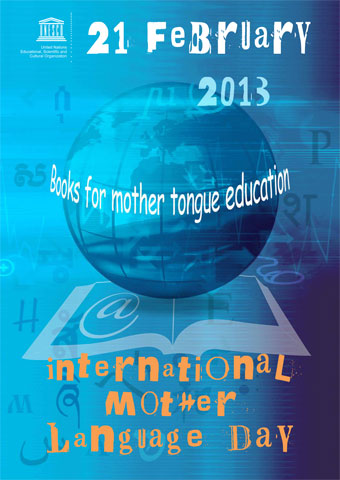 Today is International Mother Language Day, proclaimed by UNESCO to promote linguistic and cultural diversity and multilingualism. I was made aware of this by the United Nations Online Volunteering program (UNV), that I have posted about before.
 It is a real pleasure to introduce today’s guest post in the form of an interview with Johann Morri, a judge at the Administrative Court of Versailles, in France. He studied law both in France and in the United States, where he was a law clerk for a Federal Judge in the District of North California for several months. He also served at the French Ministry of Economy, Finance & Industry, where he led the international law office within the Department for Legal Affairs.
A person whose native language is said to be English created the following sentence recently:
 Following Wednesday’s post about the Bengali WordNet, I have received information about the Polish version.
The Polish wordnet – plWordNet – is a semantic network which reflects the Polish lexical system. The first ever WordNet was built in the late 1980s at Princeton University (see this post). plWordNet is one of few such resources built not by translating the English WordNet, but from the ground up, in a joint effort of lexicographers and computer scientists. It can be browsed online here: http://plwordnet.pwr.wroc.pl/wordnet/. It is the second largest wordnet in the world.
If you would like to read more about designing wordnets, see this book: http://nlp.pwr.wroc.pl/en/ksiazki/92/show/publication
Acknowledgement: Many thanks to Professor Stan Szpakowicz for granting permission to publish this post.
 Researchers at the Indian Statistical Institute have developed a lexical database for Bengali called WordNet. I have posted before about WordNet based at Princeton University in the United States.
Here is what the Indradhanush WordNet Consortium say about their project:
 The Centre for Forensic Linguistics at Aston University in the UK is organizing a day course on Forensic Authorship Analysis on Tuesday 19th March 2013.
“Linguistic evidence of who wrote a text has been increasingly accepted in the UK Courts and recent criminal cases have included murder, stalking, extortion and blackmail. The subject of these analyses can vary from long fraud documents or terrorist conspiracy texts, through shorter letters, blog posts or emails, to very short texts such as SMS text messages, Twitter streams or Facebook status updates.
 Sometimes WIRED publishes great stuff – as they did earlier this year with the article A Lawyer’s Amazingly Detailed Analysis of Bilbo’s Contract in The Hobbit.
 The UK’s Justice Select Committee has published its report on the outsourcing of court language services to Capita/Applied Language Solutions by the Ministry of Justice (see this previous post for more details). The report comes after an inquiry in September 2012, and the collection of evidence via an online forum (see this post).
 A seminar is being organized on Saturday 23 February 2013 from 11 am to 3 pm, by Professional Interpreters for Justice. The title is “Justice interpreting: The need for quality standards” and it is to be held at The Friends House, 173 Euston Road, London NW1, nearest tube: Euston or Euston Square.
Speakers will include Liese Katschinka, President of EULITA and Hilary Maxwell‐Hyslop of IoLET, Alex Tinsley, Fair Trials International, Penny Arbuthnot, Involvis PR and Press advisor, with members of PI4J’s Steering Committee.
 From Words to Deeds: translation & the law
You must be logged in to post a comment.