Conference – ‘Those Who Can, Teach’: Translation, Interpreting and Training

Saturday 10 November 2012
(date changed from Saturday 3 November)
University of Portsmouth, UK

These are challenging times for translator and interpreter training. The past 40 years have seen big changes in translator training with a shift towards greater professionalization, an explosion in the number of courses, and also a shift towards lifelong learning and continuing professional development. Translator training has also moved, in part, out of the seminar room into the virtual teaching environment. The industry and student professional needs are also changing very fast. Continue reading

Season’s Greetings

Dear Readers,

I would like to take this opportunity to wish you all a relaxing and enjoyable festive period, whether you are in a part of the world where the weather is chilly, or whether you will be basking on the beach.

You might also enjoy this politically correct festive greeting  – in language that those working in the legal world will fully understand…

I am truly delighted to report that this 3-month-old blog is attracting much interest and lots of people are signing up to receive posts.  It is great to know that someone out there wants to read what I am publishing!

Please do send me your ideas or requests for items that you would like to see included next year, either by email or in a comment below, and I will do my best to incorporate them.

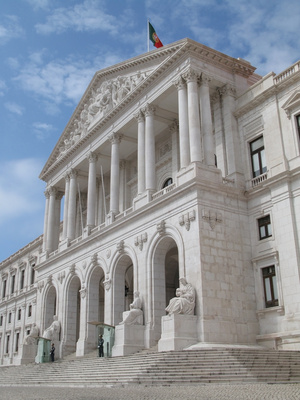
Trilingual termbase for the Portuguese Parliament

The Textual and Terminological Database for the Portuguese Parliament [BDTT-AR] is the result of a collaboration between the Portuguese Parliament (Assembleia da República) and the Centro de Linguística da Universidade Nova de Lisboa. I was introduced to this project by Rute Costa, Raquel Silva and Zara Soares de Almeida during their excellent presentation at a recent conference.

BDTT-AR is a multilingual database (Portuguese, English and French) that contains terms used within the Portuguese Parliament. Terminological information has been retrieved from texts produced within this institution, and thoroughly checked with the different working groups involved – linguists, terminologists, translators, documentalists and specialists from the different Parliament areas.
The BDTT-AR is conceived as a continuously updated dynamic database.

For me, the groundbreaking feature of this project is the collaboration between all of the above professional and multidisciplinary groups, as well as the fact that this precious resource has been made freely available. Let us hope that it will be used a model for similar future initiatives based upon cooperation.

Mixed metaphors

Not strictly a guest post, but a delightful nugget found and sent in to me by Mary Lynn, a former Vice-Consul well versed in administrative burden, and reader of this blog. The trial order came to the attention of the press in August, so you may have seen it, but if you haven’t – enjoy!

A Kentucky judge, Martin Sheehan, received news of a settlement in a bitter legal malpractice suit he had been overseeing. Sheehan summed up his feelings about the development in an order cancelling the trial: Kissel v. Schwartz & Maines & Ruby Co., LPA, et al.

Credits: Reuters/Underhill.

Collaboration or exploitation?

Something rather controversial for you today. The video presentation below discusses book digitization, use of crowd resources, and translation by non-professionals concurrently with language learning.

I think that the lawyers reading this will have plenty to say about various legal issues here, not to mention translators’ opinions.
Continue reading

OECD glossaries

For international lawyers and translators alike, the Organisation for Economic Co-operation and Development (OECD) publishes a number of comprehensive glossaries, some of which are bilingual or multilingual. I find the Corruption and Economics glossaries particularly useful. They are available as a print version, but can also be purchased in PDF format allowing them to be easily and quickly searched. Many can also be accessed through your browser.

Other subjects include, inter alia, fisheries, transport, insurance, environmental enforcement, statistics and compliance. Definitions are derived from international guidelines and standards.

http://www.oecd-ilibrary.org/glossaries

New access to supreme court rulings in French

The Juricaf database has been freely accessible to the public since October this year, and includes almost 800,000 supreme court rulings from forty French-speaking countries, including OHADA countries as well as France, Switzerland, Canada and Belgium.

I love the clear and efficient interface too.
http://www.juricaf.org/

The project is a joint initiative of AHJUCAF, the Association of francophone supreme courts (50 members), and the Laboratoire Normologie Linguistique et Informatique du droit at the Sorbonne University in Paris. It is supported by the Organisation internationale de la francophonie and other organizations promoting the French language.

In the mid-term there is a plan to produce multilingual thesauri, in particular to assist legal professionals from common law jurisdictions, which sounds very interesting indeed.

My thanks go to Library Boy, an Ottawa law librarian’s blog, and the excellent Legal Informatics Blog for their posts on the Juricaf database. This post is by kind permission of AHJUCAF.
Play with words and do some good in the world

“What if just knowing what a word meant could help feed hungry people around the world? Well, at FreeRice it does . . . the totals have grown exponentially.” (The Washington Post).

FreeRice is a non-profit website run by the United Nations World Food Programme.
FreeRice has two goals:
– Provide education to everyone for free.
– Help end world hunger by providing rice to hungry people for free.

English, German, Spanish, Italian and French are available, as well as some general knowledge subjects.

The site provides this great short video to introduce the site to new players: “Why is that important? Because the more people who play, the more rice we raise and the more people we can help. So far, we have raised enough to feed almost 5 million people.
The power of FreeRice lies in everyone doing our small part. So please share this video with friends and family, and let’s rice up against hunger!

Legal history, fish, olive oil and a call for papers

This post has a historical flavour, although it’s always surprising how much from the past is still relevant today…

Call for PapersRoman Legal Tradition. The Editor and Board of Roman Legal Tradition welcome submissions for the forthcoming issue. Roman Legal Tradition is a peer-reviewed journal dedicated to the civilian tradition in ancient, medieval, and modern law. It is published by the Ames Foundation at the Harvard Law School and the University of Glasgow School of Law.

You may also enjoy this article in the latest issue: In Dubious Battle: An Economic Analysis of Emperor Hadrian’s Fish and Olive Oil Laws by Morris Silver. Plus ça change… (or should I say semper eadem…)