 Kiva is a non-profit organization with a mission to connect people through lending to alleviate poverty. Leveraging the internet and a worldwide network of microfinance institutions, Kiva lets individuals lend as little as $25 to help create opportunity around the world.
Yearly Archives: 2012
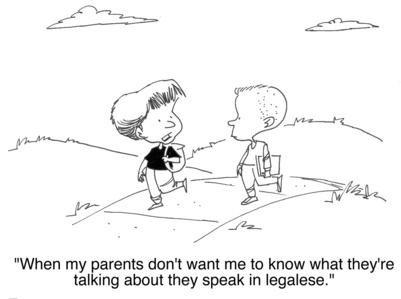
Monday smile – Out of the mouths of babes…
Problematic terms of art used in contracts
 I am delighted to present a guest post today from Kenneth A. Adams. According to the Canadian periodical The Lawyers Weekly, “In the world of contract drafting, Ken Adams is the guru.” His book A Manual of Style for Contract Drafting is widely used throughout the legal profession. He gives seminars in the U.S., Canada, and internationally, acts as a consultant and expert witness, and is a lecturer at the University of Pennsylvania Law School.
Ken’s blog contains a multitude of posts about specific terms and issues relating to contract drafting. The post below contains a number of links (terms in red) – by clicking you can find out more about each term. Over to you Ken!
*** Continue reading
Plain language in Denmark
 Following my recent post on plain language in Portugal, and yesterday’s posts on the RELINE annual seminar, today I’d like to introduce you to Lene Rosenmeier, a lawyer, journalist and lecturer on clear writing, and Anne Kjærgaard from the Danish Language Council. In this 10-minute video, they talk about the plain language tradition in Denmark, and in particular about legal language. The tongue-in-cheek film editing is by Morten Rosenmeier. 🙂
The seminar mentioned in the video is going to be held in Danish. A summary may be provided in English at a later date.
Note: If anyone is interested in joining the RELINE Special Interest Group on plain language, the network is international, so those from other countries would be welcome. Contact: Lene Rosenmeier lenerosenmeier@e-box.dk
 On the subject of plain language, I would like to invite contributions from people from other countries to post about their national situation. I am happy to present all opinions – whether for or against the simplification of legal language.
RELINE – Annual seminar 2012
 RELINE legal linguistics network (see my post describing the initiative) recently held its annual seminar in Nyborg, Denmark. The title of this year’s seminar was Talking like a Lawyer – Talking with a Lawyer, and it took place immediately after a PhD course entitled Communication and Rhetoric in the Judicial Process. Attendees were warmly welcomed by the network’s initiators and seminar organizers Professor Anne Lise Kjær and Professor Jan Engberg.
The main theme of the seminar was the significant impact that communication and lawyers’ rhetoric have on the success and outcome of lawsuits and criminal trials.
In accordance with RELINE’s purpose and spirit, the seminar was a meeting-place for researchers and practitioners from different disciplines with the opportunity to exchange research results, experience, thoughts, and ideas about the relationship between law and language. Here are some summaries of certain talks that I thought might be of interest to readers.
Professor Kati Hannken-Illjes, Musikhochschule Stuttgart, Germany
The career of arguments in German criminal proceedings
 Professor Hannken-Illjes presented an interdisciplinary research project (involving sociologists, ethnographers, lawyers, linguists) examining the pathways of lawyers’ arguments in criminal cases from the United States, the UK, and Germany (and initially also Italy).
The German strand of the project involved an in-depth examination of 16 criminal cases. During the PhD course, we had a hands-on opportunity to examine the case file, and to draw our own conclusions about the themes to be singled out as lines of argument. In her seminar presentation, the Professor focused particularly on units of analysis (topoi, themes and/or arguments), and the failures of such themes. A key conclusion of the study was that in the German system, defense attorneys become more used to ‘thinking on their feet’ following the submission of unexpected evidence which is not permitted in many systems.
Professor Lawrence Solan, Brooklyn Law School, USA
Linguistic ambiguity¹ in legal settings
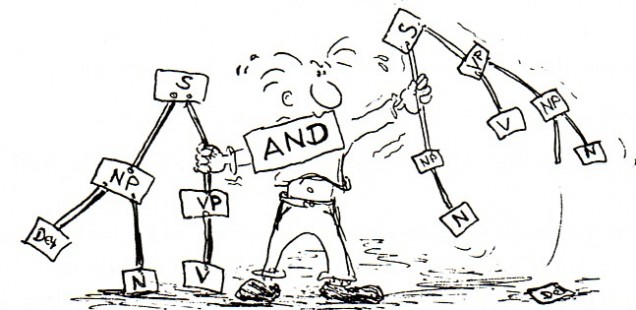 Professor Solan’s talk covered three main areas of legal interpretation – of statutes, of wills, and of contracts.
He started with differentiating three ways to interpret legal texts: a de dicto reading (of the word), de re (of the thing) and a non-specific reading.
Professor Solan gave a number of examples from case law of the above three interpretations. Regarding statues, we looked at disability legislation and bank robbery as a federal crime and saw how interpretations are wide-ranging, even “chaotic” as Solan put it. For wills, he described the situation as more “sensible” – a kind of default position. In the area of contracts, Professor Solan underlined the shift in US law from a de dicto position to that of de re, but used the word “mischief” to describe the way in which language may be ‘skewed’ by the various parties involved.
In conclusion, he underlined that in Europe a court would be extremely unlikely to ignore the purpose of a statute in order to look for “linguistic hooks” on which to hang an argument – or in other words that as regards the US, as he has said previously “it is possible to rely too much on the language itself and not enough on context to sustain a legal system with adequate moral basis“.
Walk and talk on the beach
Prof. Lin Adrian led an excellent session to mix and match participants. Despite a light drizzle, groups of 2 and 3 people that hadn’t previously been in contact got to know each other and discussed their impressions whilst walking along the shoreline. A highly recommended way to pick up flagging energy levels in the mid-afternoon.
RELINE special interest groups
 Prof. Morten Rosenmeier, Professor of intellectual property law at the University of Copenhagen, chaired a session during which the different interest groups at RELINE presented their current projects.
For the Bibliography group, Ingrid Simmonæs presented a database of research articles and publications – it includes not only references but also abstracts and conclusions, enabling scholars to assess whether the whole article falls within their interests. Shortly the database will be open access to the RELINE network, enabling members to upload and comment upon entries.
We heard about the activities of the Plain language group from Anne Kjærgaard and Lene Rosenmeier (more about that tomorrow!).
The Court group is looking not only at interdisciplinary issues but also at inter-geographical ones. So far, there have been group visits to Courts, and members include both lawyers and linguists.
The Intellectual Property Rights group is looking for more members to join its ranks, so if it’s your field – go ahead!
AND FINALLY…
 The seminar was held on a very beautiful island at a hotel on the seashore. You can see a few views on the right (click to enlarge).
Here are a few take-away quotes from the seminar:
- “Lawyers hire experts. Lawyers are insincere. Lawyers want an expert who will help them win.”
- “Legal terminology is so complex that it creates borders which lay people don’t understand.”
- “Sincerity suspended”
- “There is a low level of consciousness of language issues”
- “Outsiders don’t understand.”
- “Should law students receive linguistic training/instruction?”
- “Lawyers are windsurfers on an ocean of ambiguity!”
.
¹ For a very visual explanation of ambiguity, see this nice blog post, involving elephants, pajamas and Groucho Marx. 🙂 For a collection of practical case examples see the paper De Re and De Dicto, by R.E. Rodes, Jr.
Reporting from Canterbury – Part 3
Following two previous posts in late August (part 1 & part 2), today I would like to end my report on the Canterbury conference “Comparative Law: Engaging Translation” with a summary of Professor Gémar’s keynote talk.
Prof. Jean-Claude Gémar, Universities of Montreal & Geneva
Law’s labours: Lost or gained in translation? Language, law and translation.
 The highly eminent Professor Gémar treated* us to “21 ways to look at translation” (both general and legal). It was a whistle-stop tour of more or less every important issue for translators and translation. These are the main points only – the full paper will be published in the conference proceedings.
- Translating: from Babel to Babel** – ancient and modern
- What translation is (and is not all about) – source and target; facilitating communication
- Translation: ways and means – methods and strategies
- Translation and equivalence
- Translation: an art, a craft or a “science”?
- Language and translation: general vs technical
- Law and translation: a natural or forced partnership?
- The specificity of legal texts
- Translating legal texts, translation problems
- The translator is a sorcerer’s apprentice
- Translation’s semper fi, but the translator is always confronted with novel textual conditions
- Translation is governed by cultures
- Linguistic vs legal equivalence
- Translation is not a matter of words
- The length of the translated text
- Sense-giving and sense-reading
- It is always possible to say the same thing… differently
- French and English: two (linguistic) solitudes
- The good, the bad, and… the worse
- The quest for the grail: in search of the best translation method
- The translator: interpres ut orator?
 Professor Gémar concluded with some enlightening statements and citations: “to translate is to seek truth without the expectation of resolution”. “Language signs [are…] far more mysterious than atoms and stars”. “A translation, particularly a legal one, is but an approximation, if not a compromise”. “This quest for equivalence is […] for the translator, a herculean effort and task”. “How can we translate into French or Spanish (or whatever language) Mary Poppins’ supercalifragilisticexpialidocious? We shouldn’t even try!”
*and it was a real treat – if you have the opportunity to hear him speak in person, don’t miss the chance.
** The translation journal Babel
 You might also be interested to listen to a recording of Professor Gémar speaking (in French) at the University of Montreal in their conférences midi series, entitled “Traduire le droit: de la traduction juridique à la jurilinguistique – Texte(s), culture(s) et équivalence”. Click to access the video.
What exactly is corpus linguistics?
This post, in my mini-series of posts entitled ‘What exactly is…”, will try to give an overview of Corpus Linguistics and hopefully pique your interest to find out more.
 First of all, a definition: a corpus is a collection of texts, often used to study language. These days, corpora are generally held electronically – access is much faster and analysis can be more powerful.
CPD at City University, London
 To round off this week on training, here are some details of the Continuing Professional Development (CPD) courses offered by City University in London, UK.
City University also offers an MA degree in legal translation (see this post).
Legal translation seminar in Kentucky
 An Advanced Seminar in Understanding the Nuances of the Law in Spanish and English for bilingual legal professionals is to be held at the University of Louisville, Louisville, Kentucky from November 2-4 2012, comprising 19 hours Continuing Education Units.
Lexacom face-to-face legal terminology workshops
 Back in March, I posted about a series of legal terminology webinars presented by David Hutchins of Lexacom. Today I’d like to make you aware of his autumn programme of face-to-face courses to be held in London, England. The courses can also be organized for groups elsewhere – recent venues have been Prague, Bologna, Copenhagen and Stockholm, for example.
David’s courses are aimed at bringing knowledge of English common law both to lawyers from civil law jurisdictions, and to legal translators and interpreters.
David’s face-to-face courses are highly motivating and fast-paced, and have been very favorably reported on two occasions by the Institute of Translation & Interpreting (ITI) – to see the articles click here, as well as being recommended for lawyers by the German DeutscheAnwaltAkademie and the Swedish Armed Forces.
In particular, I think that it is extremely refreshing that a solicitor of such experience is interested in working with translators, listening to their comments and generating such rich interaction – building those bridges I keep talking about… 🙂
PROFILE
 David Hutchins has been a solicitor since 1967. He was until 1998 the Senior Partner of Hutchins & Co, Solicitors, London, a firm he founded in 1971. He has been responsible for, inter alia, the selection and supervision of trainee solicitors. He is currently a Practising Consultant with the firm.
His legal experience includes conveyancing, wills, probate, landlord and tenant, commercial contracts, employment law, criminal law, family law, professional negligence, personal injury claims and general civil litigation. He has been a frequent Guest Speaker on ‘English for Lawyers’ courses and is also an experienced small-group presenter. He speaks and reads French and has a working knowledge of German, Italian, and Latin. He was formerly a QLTT (Qualified Lawyers’ Transfer Test) Oral Test Assessor for Altior Consulting & Training Ltd on behalf of the SRA (Solicitors Regulation Authority).
Important information for those in France who can pop over to London: Reimbursement of all or part of the course fee from FIF PL may be possible for French residents: an application may need to be made well in advance of the course date but see their website.
Regarding disclosure, I have no commercial relationship of any kind with the company Lexacom, and provide the above details purely for information purposes.
 From Words to Deeds: translation & the law
You must be logged in to post a comment.