Book review – Found in Translation

I feel sure that most readers who are translators will already have heard about the book Found in Translation by Nataly Kelly and Jost Zetzsche, but just in case any haven’t, and for all those who are not translators…

I’m not going to reinvent the wheel here, because a whole raft of reviews of this excellent paperback can now be found on the Internet. Just a few details, hopefully to pique your interest.

The idea behind the book was to raise awareness of the profession of translator and that of interpreter. It sets out to demonstrate how translation affects all aspects of our existence, from saving lives, protecting rights, war and peace, business, religion, pleasure and the senses, the arts and sport, to technology.

It includes a few law-related items too: stories about interpreting for the police and for the courts, interpreting for war criminals…

Here is a link to the book’s website: http://www.xl8book.com

As the authors have said – once you’ve read it yourself, do buy it as a Christmas present for the non-translators you know. Let’s try to finally turn translation and interpreting into ‘visible’ and respected professions!

Before & after the DSK affair – Review

A few weeks ago, I was invited by Jonathan Goldberg of the blog Le mot juste en anglais to review a paper, Les conceptions juridiques du harcèlement sexuel en France et aux USA – Avant et après l’affaire DSK¹, comparing the way in which the law sees sexual harassment in the United States and in France. I am thus in the slightly odd position of reviewing a paper originally written in English, but finalized in its French version, where my review itself is to be written in both English and French! Anyway, back to the point.

One of the opening statements in Abigail Saguy’s article is the affirmation that the Dominique Strauss-Kahn (DSK) scandal could only have erupted in the USA². She then analyses the laws, legislative debate and case law over a period from the 1960s (in the US and rather later in France) to the present, in support of her argument that the scandal has also changed the “political and legal landscape” and “might influence the way in which France deals with sexual harassment cases in the future”.

Continue reading

Quantifying the cost of poor quality in translation – sour cherries

The Directorate-General for Translation of the European Commission has made available a report written late last year, as part of the ‘Studies on translation and multilingualism’ series, on Quantifying Quality Costs and the Cost of Poor Quality in Translation. The document can be downloaded in PDF format here.

Items such as prevention of poor quality, evaluation, and clarification of original texts may be of interest to those of you procuring translation as well as to translators. Some case studies from ‘real life’ have been given.  One interesting example relates to protective measures on the import of sour cherries which accidentally became “sweet cherries” in the initial German version.

Continue reading

Council of Europe French-English Legal Dictionary

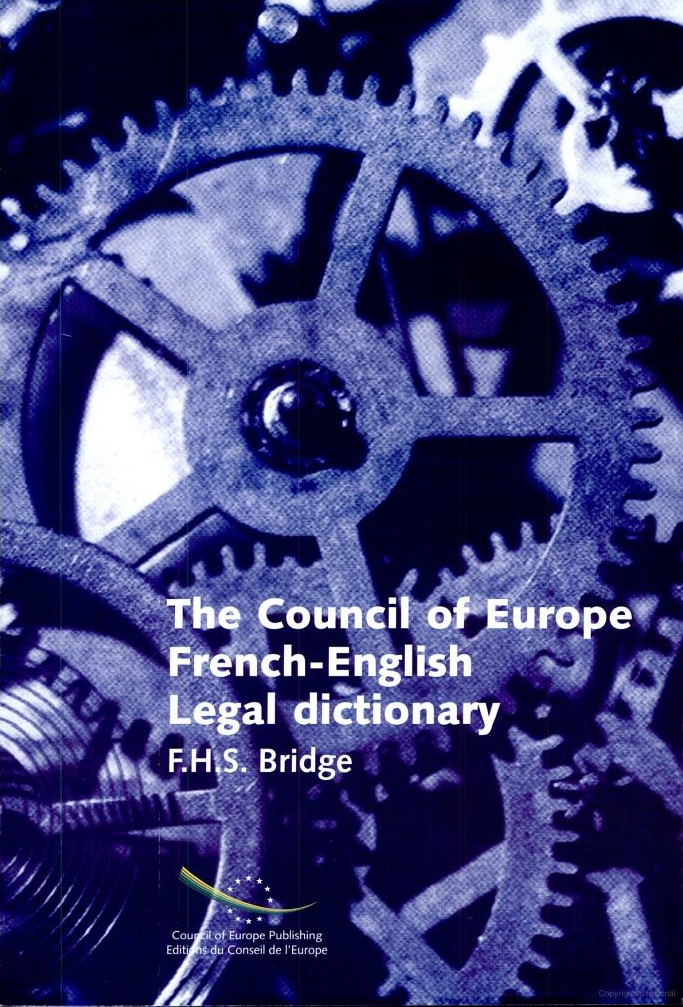
For anyone who has recently starting working in the language pair French to English, or those who might not already have heard of it, the Council of Europe French-English Legal dictionary by F.H.S. Bridge, published in 1998, is a well-known and highly regarded resource.

The dictionary contains some 11,000 entries. One of the best things about it from my point of view is the layout – most words are given as a kind of heading showing words below that often collocate with it, as you can see from the image below – just click to enlarge.

Continue reading

Two great legal thesauri

First off, the Multilingual Thesaurus of the European Union, EuroVoc, has been upgraded. Available in 24 languages, it doesn’t work quite like other thesauri, but I think it’s a really good way to think around a topic, or find out about it. You can browse the subjects (“Browse the subject-oriented version“), which include Community and national fields, “with a certain emphasis on parliamentary activities” – from law to trade, finance, agriculture and so on.

Continue reading

Legal Translation Explained

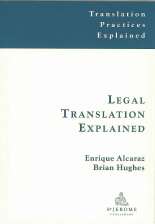
A few days ago I realized that I hadn’t included a book review for quite a while. Although this book was published in 2002, it is still really useful, and as far as I can tell, about the only one on the market to be such a comprehensive theoretical reference whilst being totally accessible and clearly written. When I read it, I gobbled it down in just a couple of days. It covers English, Spanish, French and German, but would probably also be of use to people working from other languages into English.

This is what the publisher, St Jerome, has to say: “The scope of the book makes it useful not only for would-be translators, but also as a reference source to anyone with a background in any of the languages used in the book, who would find the explanations and glossed terminology an aid to becoming familiar with the English legal system and vocabulary. It could also serve as a basic introductory text to anyone with an interest in legal English. (Lucy Cox, International Journal of Legal Information)

Here is a link to the publisher’s contents page so you can see whether it might be of use to you.

Britain’s ancient statute book

This week a report produced jointly by the Law Commission for England & Wales (LCEW) and the Scottish Law Commission recommends repealing more than 800 pieces of legislation dating from the 14th century onwards in order, according to LCEW chairman Sir James Munby,  “to simplify and modernise our law, making it more intelligible. It saves time and costs for lawyers and others who need to know what the law actually is, and makes it easier for citizens to access justice. We are committed to ridding the statute book of meaningless provisions from days gone by and making sure our laws are relevant to the modern world.”

Here’s where the fun starts, though – some of those laws include:

Continue reading

Another excellent Spanish legal dictionary

This week is proving to have a distinctly hispanophone flavour. That has had me dreaming about tapas of course… hoping to indulge on a possible work trip to Madrid in the near future.

Anyway, back to dictionaries. This recently published work was brought to my attention by Professor Esther Monzó at University Jaume I (Spain). She thoroughly recommends it, having had personal experience of the original glossaries.

Continue reading

English-Spanish / Spanish-English legal dictionaries

Today I am delighted to tell you about two Spanish-English and English-Spanish dictionaries of Mexican and US legal terminology. They were kindly brought to my attention by their author, Javier F. Becerra.

It is important to stress that the dictionaries not only provide translations of legal concepts, but also include explanations of such concepts in the target language and in some cases examples of use.

Javier studied law at the Escuela Libre de Derecho in Mexico City and after graduating in 1967, undertook postgraduate studies in England, in the field of comparative law at Cambridge University, as a member of Trinity College. He worked for more than 40 years with a leading Mexico City law firm, first as an associate and then as partner and managing partner.

Continue reading